A Dam Across the River of Time From a Chinese Documentary to the Narrative Labyrinth of the Arabian Nights
Footnotes to the Floating World · The passing world, closely examined.
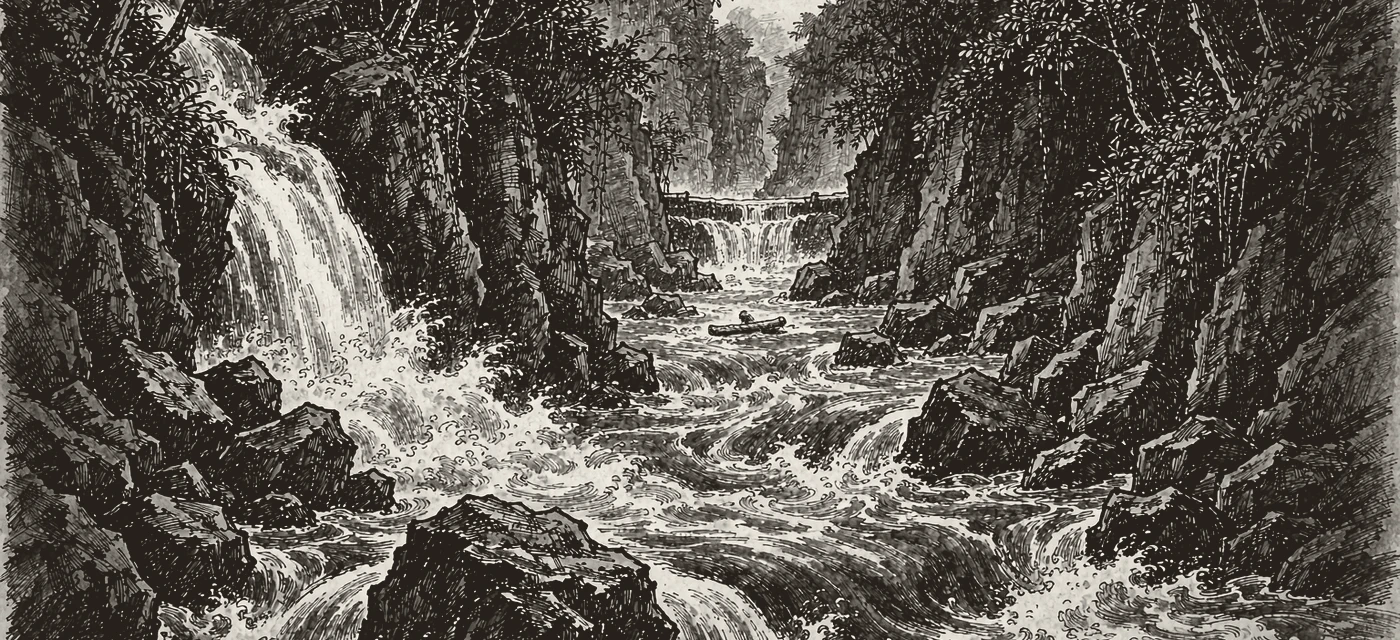
Over a decade ago, I caught a documentary segment on Chinese state television—something along the lines of CCTV’s human-interest series Jiangshu—recounting a remarkable river rescue. The bare facts were simple enough: a woman had slipped into a swift-moving river upstream in Guizhou province, been carried miles downriver through rapids and gorges, and was eventually pulled alive from the water across the provincial border in Hunan.
With the passing years, her name, the exact counties, and most details of the rescue have blurred in my memory. What never faded was the opening shot. The television director neither chose a dutiful chronological beginning—starting at the riverbank in Guizhou where she lost her footing—nor fell back on the standard documentary flashback of showing her safely awake in a Hunan hospital before rewinding the tape. Instead, the camera cut cleanly into the middle of the ordeal: an unremarkable, low river weir spanning a muddy current, water spilling heavily over its lip, and the woman drifting precariously across it.
For a few seconds, the viewer was caught between two opposing psychological pulls. One tugged backwards into the past: Who is she? How did she end up alone in this current? What happened miles upstream in Guizhou? The other pulled anxiously into the future: What lies beyond this modest weir? How far is she from safety—and does she survive?
Two millennia ago, the Roman poet Horace gave this gambit its enduring Latin name in his Ars Poetica: in medias res (“into the middle of things”), dryly warning writers not to open an epic on the Trojan War ab ovo—literally, from the egg out of which Helen was hatched1. Only years later, after dipping into narratology, did I realise that an anonymous television editor had quietly given me my first lesson in narrative form. The raw physical event never changes; alter the point of entry, the sequence, or the pause, and the exact same sequence of facts exerts an altogether different gravitational pull.
That ordinary low weir momentarily checked the river’s rush; the director’s edit checked the linear flow of time. Trace that instinct back to the wellsprings of oral literature, and one arrives at a monument where damming time became an entire hydraulic system: One Thousand and One Nights.
I. “Narrating Equals Living”: Todorov’s Grammar of the Nights
Why does shifting a story’s entry point change its hold over us so sharply? In The Poetics of Prose (Poétique de la prose, 1971), the Bulgarian-French structuralist Tzvetan Todorov offered an explanation that remains startlingly lucid.
In “The Typology of Detective Fiction,” Todorov drew a neat distinction between two mental engines that keep a reader turning pages2. The first is suspense, which moves forward from cause to effect: we know danger is underway and wait nervously to see what follows. The second is curiosity, which moves backwards from effect to cause: the narrative confronts us with an inexplicable situation and compels us to ask how on earth it came about2.
Seen through Todorov’s lens, the documentary’s opening shot of the river weir succeeded because it fired both engines at once. A woman swept over a low dam is an arresting effect demanding an upstream explanation (curiosity), yet an unfinished crisis whose outcome hangs in the balance (suspense). Strict chronology delivers only mild suspense; opening in the hospital bed spoils the survival and drains the tension. Only cutting into the middle holds the audience suspended between both forces.
In a companion essay in the same volume—“Narrative-Men” (Les hommes-récits)—Todorov turned this structuralist scalpel onto One Thousand and One Nights3.
The book’s outer frame is itself a life-or-death dam built against time. Betrayed by his queen, King Shahryar resolves to marry a new maiden each night and execute her at dawn. Scheherazade, the vizier’s daughter, volunteers to wed him, spins a captivating tale each evening, and stops precisely as daylight breaks at the most tantalising juncture3. To hear the ending, the king postpones the executioner’s blade one day at a time. Every dawn pause in Scheherazade’s voice is a weir holding back morning—and death.
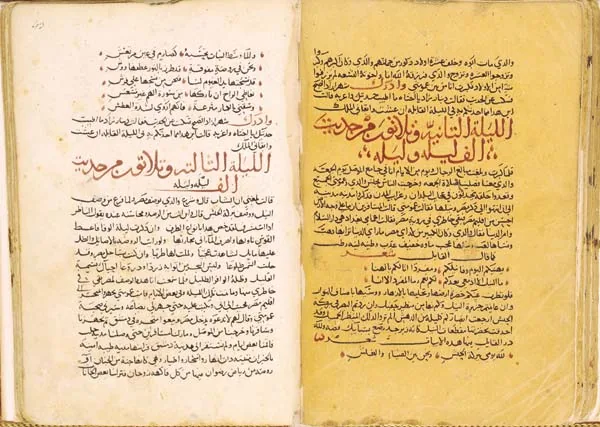
From this architecture, Todorov coined the memorable term “narrative-men”3. Unlike modern psychological realism—think of Dostoevsky or Henry James, where plot grows slowly out of tormented inner lives—the Nights is resolutely apsychological. Characters are rarely given brooding motives or gradual development; they exist as vessels for stories. The moment a new figure enters a scene, his sole narrative justification is to open his mouth and recount his own tale; once his story ends, his reason for being vanishes3.
Todorov distilled the entire collection into one stark syntactic law: “narrating equals living” (Raconter égale vivre), whereas silence is indistinguishable from death3.
Without psychological depth to expand a book across a thousand nights, classical storytellers relied on a structural device Todorov called embedding—the story within a story. Borrowing from linguistics, he likened narrative embedding to a subordinate clause in grammar3: whenever a new noun appears in a main sentence, a clause may branch off to explain it; likewise, whenever a new character walks into Story A, he opens Story B to account for himself, inside which another figure opens Story C3.
This downward nesting is rarely mere ornament; it locks directly into the survival stakes above. Early in the book, in The Fisherman and the Jinni, a fisherman frees a murderous spirit from a brass jar and promptly embeds the cautionary fable of King Yunan and the physician Duban—holding up a mirror to ingratitude that saves his own neck3.
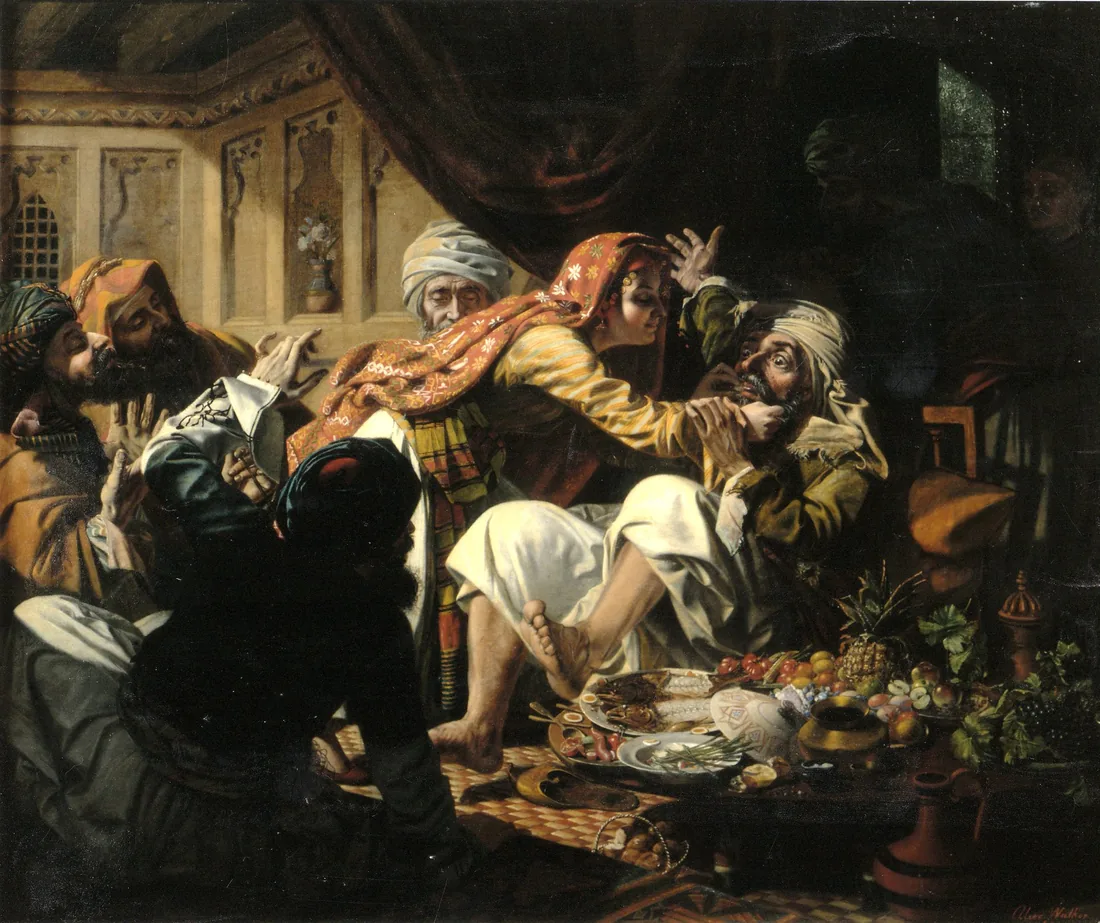
Nowhere, however, does embedding achieve greater ingenuity than in The Tale of the Hunchback—a four-tier Russian doll housing eleven stories4. On the outer tier, four citizens each mistakenly believe they have accidentally killed the king’s favourite jester, a hunchback, and compete to confess on the gallows. The king decrees that if any of them can tell a true story stranger than that night’s fiasco, all four will be spared4. The narrative plunges downwards: the execution square embeds the confessions of the four suspects; the tailor’s account embeds the woes of a lame young man; and the young man’s lament embeds the endless digressions of a notoriously talkative Baghdad barber recounting the misadventures of his six brothers4.
When every branch finally folds back to the royal court on the first tier, the coup de grâce arrives. Intrigued by the tailor’s tale, the king learns that the garrulous barber still lives in the city and summons him to court4. Stepping forward to inspect the supposed corpse, the barber pulls out a pair of pincers, reaches into the hunchback’s throat, and extracts a lodged fishbone—whereupon the hunchback lets out a hearty sneeze and springs back to life4. A minor figure who had existed only inside a fourth-level subordinate clause walks straight out into the primary frame and resolves the crisis with a pair of tweezers.
II. Mirrors Within Mirrors and “Night 602”: Borges’s Metaphysical Mischief
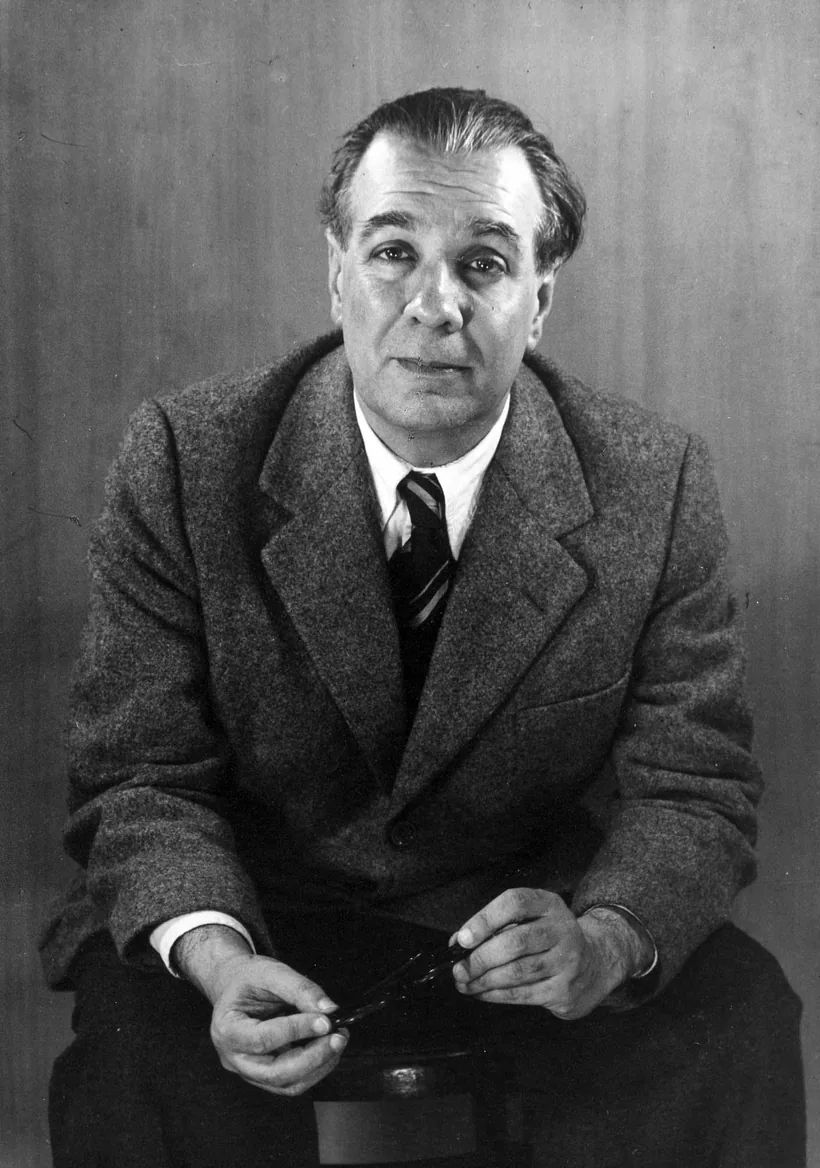
If Todorov examined One Thousand and One Nights like a watchmaker laying out its springs and gears, the Argentine writer Jorge Luis Borges spent a lifetime gazing into its metaphysical reflections.
The Nights served Borges as an inexhaustible reservoir of archetypes. In his early collection A Universal History of Infamy (Historia universal de la infamia, 1935), he retold the classic Tale of the Two Dreamers5: a man in Cairo dreams of a voice directing him to a hidden treasure in Isfahan; arriving battered and penniless in Persia, he is arrested as a thief and beaten. The captain of the watch laughs at his gullibility, remarking that he himself has thrice dreamt of a house in Cairo with a sundial and a fig tree hiding a buried fortune—describing, down to the courtyard, the Cairo dreamer’s own home5.
For Borges, the tale distilled nesting into a spatial metaphor for fate. One must leave the first tier of home, travel to an alien city (the second tier), and look into a stranger’s dream (the third) before one can recognise one’s own starting point. Good narrative, in Borges’s imagination, is never a straight highway from A to B, but a labyrinth of mirrors folding inward.
Yet the episode Borges returned to with the deepest fascination—most famously in his 1949 essay “Partial Magic in the Quixote” (Magias parciales del Quijote)—was a dizzying paradox he assigned to Night 6026.
With utter composure, Borges wrote that among all stories containing themselves, none is more magical than Night 602 of the Arabian Nights6. On that night, he explained, King Shahryar hears his own story from the lips of the queen: Scheherazade begins recounting the very opening of One Thousand and One Nights, threatening—unless the king stops her—to reach Night 602 once again inside her own tale and tumble into an infinite regress6.
Setting Night 602 beside the play-within-a-play in Hamlet and the second volume of Don Quixote (in which the knight reads and critiques the first volume), Borges delivered his celebrated, quietly unsettling verdict: “These inversions suggest that if the characters of a fictional work can be readers or spectators, we, its readers or spectators, can be fictitious.”6
Stop there, however, and you miss the most deliciously Borgesian twist of the whole affair.
Once the essay became famous, enchanted readers and writers hurried to their bookshelves and flipped straight to Night 602—only to come up conspicuously empty-handed7. The Italian novelist Italo Calvino searched in vain and remarked with affectionate resignation: “I have not managed to find this 602nd night. Yet even if Borges had invented it, he would have done well to invent it.”7
Decades later, Borges scholars—most notably Evelyn Fishburn—played textual detective across the major European editions of Burton, Payne, Lane, Littmann, and Galland7,8. What they uncovered was subtler than an outright hoax, yet scarcely less mischievous. Around Night 602 in Burton’s and Littmann’s translations, there does appear a brief episode (The King’s Son and the Afrit’s Mistress) whose plot faintly echoes an ordeal Shahryar and his brother suffered in the frame story, prompting the king to exclaim that the tale mirrors his own case7. Nowhere in any canonical translation of Night 602, however, does Scheherazade actually start retelling the entire Thousand and One Nights from page one7.
In other words, Borges lifted a modest, glancing mirror from a dusty Victorian footnote and—whether through a lapse of memory or deadpan literary sleight of hand—polished it into an infinite hall of mirrors7,8. Few critics in literary history have managed to slip an extra page into a thousand-year-old classic inside a book review and keep the world’s scholars hunting through indices for half a century. The bibliographic slip itself became the finest proof of his thesis: fiction quietly rewriting the shelf it sits upon.
III. Building a Weir Between the Fall and the End
Return, finally, to that muddy current from the start—the woman who fell into a river in Guizhou, drifted across an unremarkable low weir, and was pulled to safety across the border in Hunan.
Strip away every editorial choice, and the event collapses back into cold physics and linear causality: a slip, a fall, a current, a rescue—or, in too many unrecorded tragedies, a silent ending. Real time behaves much like an indifferent river, sweeping each individual steadily downstream towards ageing and departure.
That may explain why human beings have gathered around stories since the first campfires, endlessly devising flashbacks, nested clauses, in medias res cuts, and Borgesian mirrors. Beneath the technical craft lies an ancient refusal to surrender passively to single-file time.
The television editor freezing our gaze at that modest river weir was using montage to hold back a current that nearly claimed a life; Scheherazade pausing at every dawn was building a labyrinth of words to buy another morning for herself and the daughters of the city; and Borges, folding mirrors inside his essays and his half-imagined Night 602, was using verbal geometry to push back against finitude itself.
Every deliberate narrative structure is, in the end, a dam built across the river of time—rarely grandiose, sometimes no taller than an ordinary stone weir. We rearrange causes, tuck subordinate clauses inside main sentences, and open dreams within waking life not to deny the river’s destination, but to carve out a quiet eddy between the fall and the end. Inside that brief pocket of held water, time slows down long enough for an ordinary life to be watched, understood, and remembered before the current carries on.
References · 8 entries
- Horace. (c. 19 BCE). Ars Poetica [Lines 147–149, ab ovo and in medias res]. The Latin Library. https://www.thelatinlibrary.com/horace/arspoet.shtml
- Todorov, T. (1977). The typology of detective fiction. In The poetics of prose (R. Howard, Trans., pp. 42–52). Cornell University Press. (Original work published 1971). [Internet Archive]. https://archive.org/details/isbn_0801491657
- Todorov, T. (1977). Narrative-men. In The poetics of prose (R. Howard, Trans., pp. 66–79). Cornell University Press. (Original work published 1971). [Internet Archive]. https://archive.org/details/isbn_0801491657
- Payne, J. (Trans.). (1882). Story of the Hunchback. In The book of the thousand nights and one night (Vol. 1). Villon Society. [Wikisource]. https://en.wikisource.org/wiki/The_Book_of_the_Thousand_Nights_and_One_Night/Story_of_the_Hunchback
- Borges, J. L. (1972). A universal history of infamy (N. T. di Giovanni, Trans.). E. P. Dutton. (Original work published 1935). [Internet Archive]. https://archive.org/details/universalhistory0000borg_k2f9
- Borges, J. L. (1964). Partial magic in the Quixote. In Labyrinths: Selected stories & other writings (D. A. Yates & J. E. Irby, Eds.; J. E. Irby, Trans.). New Directions. (Original work published 1949). [Internet Archive]. https://archive.org/stream/borges-jorge-luis-book-of-sand-gold-of-the-tigers-penguin-1981/Borges%2C%20Jorge%20Luis/Labyrinths/Borges%2C%20Jorge%20Luis%20-%20Labyrinths%20%28New%20Directions%2C%201964%29_djvu.txt
- Fishburn, E. (2004). Readings and re-readings of Night 602. Variaciones Borges, 35–42. [Dialnet]. https://dialnet.unirioja.es/servlet/articulo?codigo=2411841
- Irwin, R. (1994). The Arabian Nights: A companion. Allen Lane. [Internet Archive]. https://archive.org/details/arabiannightscom0000irwi
Say Something